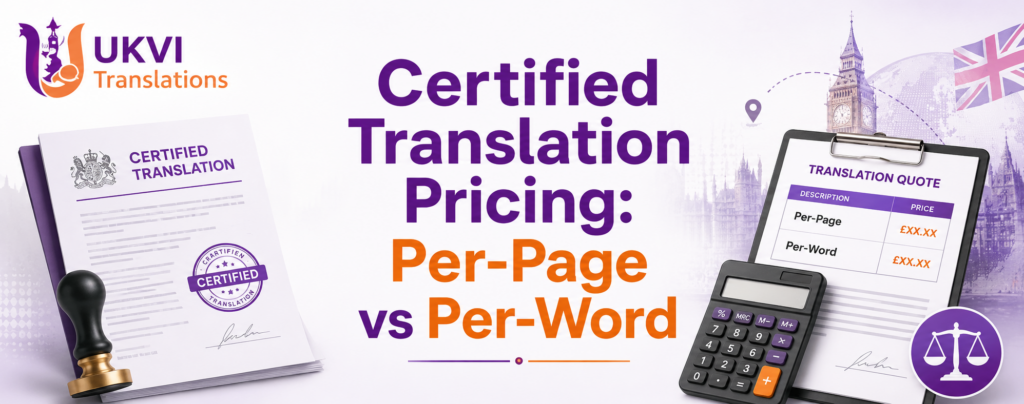
Certified translation pricing is usually based on one of two models — a flat rate per page, or a rate per word. For visa documents, per-page pricing is the more common and more predictable model, because you know your exact total before any work starts. Per-word pricing can look cheaper on paper, but your final bill is only confirmed once the document has been counted.
Most people have no way of judging whether a translation quote is fair, because nobody ever explains how the number is built. That uncertainty is the real problem, not the price itself. We have quoted on thousands of visa document sets, and the applicants who feel most confident are always the ones who understand the maths behind their invoice. At UKVI Translations we publish our rates openly for exactly that reason. Below we break down how certified translation pricing actually works, what changes your quote, and what a realistic visa document set costs from start to finish. Understanding certified translation pricing can help visa applicants compare quotes and avoid unexpected costs.
How Does Certified Translation Pricing Work?
Certified translation is priced either per page or per word, with the certification itself either included or charged separately. Everything else — urgency, language, document condition — adjusts that base rate.
Six factors decide what you pay:
- The pricing model. Per page or per word. This is the biggest single variable, and we compare both below.
- Volume. How many pages or words in total across all your documents.
- Language pair. Common European languages cost less than rare ones, simply because fewer qualified translators exist for those pairs.
- Document condition. A clean printed certificate is quicker than a faded, handwritten registry entry with seals in a second script.
- Turnaround. Same-day and overnight work carries a premium with most providers.
- Extras. Certification, notarisation, apostille, and posted hard copies may or may not be inside the quoted price.
That last point causes more disputes than anything else. Two quotes that look £10 apart can end up £60 apart once extras are added. For visa applications, you should also check the latest GOV.UK translation requirements before ordering a certified translation.
What Counts As One Page In Certified Translation Pricing?
A “page” normally means one side of a standard A4 document, not a full sheet and not a fixed word count. But definitions do vary, so this is worth confirming before you order.
Some providers define a page by word count instead — commonly 250 or 300 words — which means one dense A4 sheet could be billed as two pages. Others count every physical side, including the reverse of a certificate that only carries a stamp.
Here is what we count as one page: one side of a document, regardless of how many words are on it. A birth certificate with a translated reverse side carrying an official stamp is two pages, because both sides genuinely need translating and certifying.
Ask any provider this exact question before you commit: “Is a page one A4 side, or a set number of words?” The answer tells you a great deal about how transparent their pricing is.
Is Per-Page Or Per-Word Cheaper For Visa Documents?
For most visa document sets, per-page works out cheaper and far more predictable. Per-word can win on very short documents, but rarely on a full application bundle.
The reason is simple. Visa documents are dense. A single bank statement page can carry 400–600 words of transaction data. A police clearance certificate with full-page terms on the reverse can run higher. At a per-word rate, that density is billed directly to you. The difference between per-page and per-word rates is an important part of certified translation pricing.
| Per-page pricing | Per-word pricing | |
|---|---|---|
| When you learn the final price | Before work starts | After the document is counted |
| Dense pages (bank statements, transcripts) | Same flat rate | Cost rises with word count |
| Short documents (short certificates) | Flat rate applies | Can be cheaper |
| Minimum charge | Usually none | Minimum order fees are common |
| Comparing two quotes | Easy — page count is visible | Harder — word counts differ by method |
| Budgeting for a full set | Straightforward | Estimate only |
One more detail that catches people out with per-word pricing: some providers count source words and others count target words. Translating from a compact language into English can increase the word count considerably, and if the count is taken from the finished English text, your bill grows with it.
Why Do Two Documents Of The Same Length Cost Different Amounts?
Because certified translation prices the difficulty of the work, not just the volume. Two one-page certificates can take very different amounts of time.
These are the things that move a price up:
- Handwriting. Older registry entries from South Asia, the Middle East and East Africa are frequently handwritten, sometimes in fading ink.
- Seals, stamps and marginal notes. These must all be described in a certified translation, not skipped. A certificate covered in stamps carries more work than its word count suggests.
- Second scripts. A document with an Arabic seal on an otherwise Urdu certificate needs someone comfortable with both.
- Poor scan quality. A dark, angled photo takes longer to work from than a clean scan — and sometimes we have to come back to you for a better copy.
- Layout matching. A certified translation should mirror the original’s structure so a caseworker can compare them side by side. Complex tables take longer than plain text.
- Rare language pairs. Fewer qualified certified translators means a higher rate.
Does The Price Include Certification And The Stamp?
With us, yes — certification is part of the price, not an add-on. But you should check this with every provider, because it is a common place for extra charges to appear.
Before you pay anyone, ask about these seven items:
- Certification fee. Is the certificate of accuracy included, or charged per document?
- Company stamp. Some providers charge separately for a stamped version.
- Minimum order charge. Common with per-word pricing, and it can double the cost of a single short certificate.
- Rush surcharge. What is the premium for same-day, and when does it apply?
- Hard copy and courier. Posted copies almost always cost extra. Most visa applicants never need one — we have explained why in our guide on whether an online certified translation is valid for UKVI.
- Notarisation or apostille. These are genuinely separate services with separate costs. If your case needs them, our translation covers it — but most standard visa applications do not require either.
- Revisions. If a name spelling needs correcting, is that free?
Our own answers, in order: included, included, none, no surcharge on standard same-day work, only if you request it, quoted separately and only when your case needs it, free. Our FAQ page sets this out in full.
What Does Certified Translation Pricing Look Like For A Full Visa Document Set?
A typical spouse visa document set runs to around 10 pages, which comes to roughly £250 at our visa rate. Here is the actual breakdown so you can plan properly.
Take a common example: an applicant from a non-English-speaking country applying for a partner visa.
| Document | Pages | Our rate | Cost |
|---|---|---|---|
| Birth certificate | 1 | £25 | £25 |
| Marriage certificate | 1 | £25 | £25 |
| Police clearance certificate | 2 | £25 | £50 |
| Bank statements | 6 | £25 | £150 |
| Certification and stamps | — | Included | £0 |
| Total | 10 | £250 |
Now price the same set per word. Those six bank statement pages are dense — assume roughly 500 words each, so 3,000 words from the statements alone, plus around 900 across the three certificates. At a typical market rate of £0.10–£0.14 per word, that same set lands somewhere between £390 and £546, before any certification or minimum charges are added.
That is the gap. It is not always this wide, and on a single short certificate per-word can genuinely be cheaper. But on a real visa bundle, density works against you.
Our rates vary by application type — £20 per page for student documents, £25 for visa and family applications, £30 for settlement, ILR and skilled worker cases, and £35 where court or notarised work is involved. You can see the full table on our homepage.
If you want to know which documents you are likely to need in the first place, our UK spouse visa document checklist walks through the full list.
How To Compare Certified Translation Pricing And Get An Accurate Quote
Send the actual files rather than describing them. A quote based on a description is a guess; a quote based on your documents is a commitment.
To get a firm number back quickly:
- Send every page, including reverse sides carrying only a stamp.
- Make the scans clear — flat, upright, in focus, nothing cropped at the edges.
- State your deadline, so any urgency options are priced in from the start.
- Say who it is for — Home Office, a university, a court or an embassy. Requirements differ, and so does the rate band.
- Ask for the total in writing, not a per-unit rate. A rate is not a price until it is multiplied by something.
We come back with a fixed total within 30 minutes. That figure is what you pay — not a starting point that grows once the work is underway. Our client reviews are the fastest way to check we mean that.
Frequently Asked Questions
Do Translators Charge Per Page Or Per Word?
Both models are used. Certified translation for official documents is most commonly priced per page, because those documents are short, standardised and need certifying individually. Per-word pricing is more typical for long commercial texts. For visa paperwork, per-page pricing gives you a firm total upfront.
How Much Does Certified Translation Pricing Cost For A UK Visa?
Certified translation for UK visa documents typically starts around £20 to £35 per page depending on the application type and provider. Our visa document rate is £25 per page with certification included. A full spouse visa document set usually falls between £150 and £400 in total.
Is A Cheaper Translation More Likely To Be Rejected?
Price alone does not cause rejections — missing certification does. A translation is accepted when it is complete, accurate, and carries a signed certificate of accuracy with the translator’s name, date and contact details. Check that those elements are included at any price point.
Is Vat Added On Top Of The Quoted Price?
Always confirm this before ordering, as it varies between providers and can add a fifth to your bill unexpectedly. When we send you a fixed quote, the figure shown is the figure you pay. No tax, certification or handling charges appear afterwards.
Does A Same-Day Translation Cost More?
Many providers apply a rush surcharge for urgent work. We deliver certified translations in as little as four hours on standard visa documents without a separate express fee, though very long or unusual language documents are quoted individually. Tell us your deadline and we will confirm before you commit.
Get A Fixed Price Before You Commit To Anything
By understanding certified translation pricing, you can choose the right pricing model for your visa documents. We have seen how much stress the money side of this adds, on top of everything else an application demands. That is why we quote the way we do. Send us your documents and you will have a firm total back within 30 minutes — one number, covering translation, the certificate of accuracy, our company stamp and delivery, with nothing added afterwards. Our translators are independent, professionally qualified linguists, and we have delivered over 12,000 documents with a 99.4% first-time acceptance rate. If a translation of ours is ever rejected because of our certification format, we correct it free of charge. There is no minimum order, so a single certificate is just as welcome as a full settlement bundle. Upload your files and see your exact price — then decide.
Get your free fixed quote in 30 minutes → Or message us on WhatsApp if your deadline is close and you want a straight answer today.