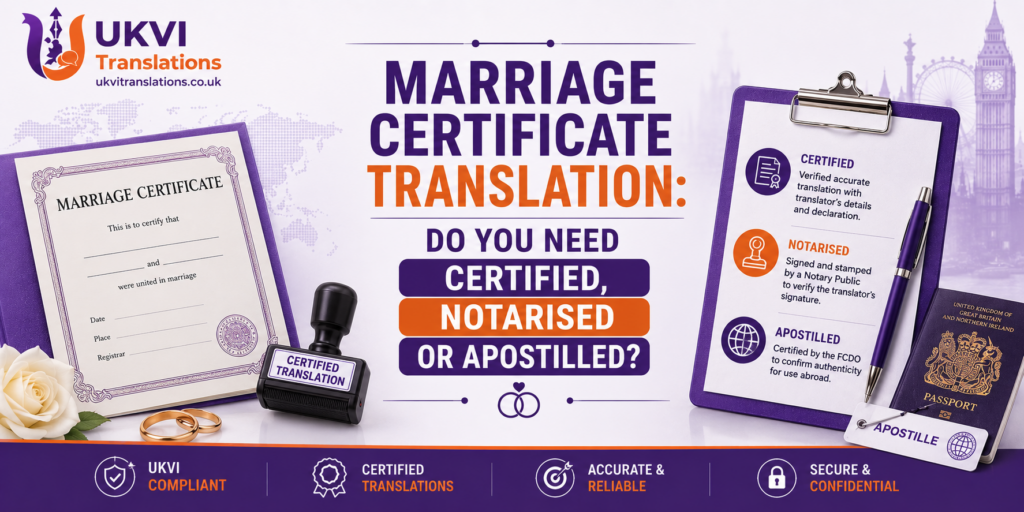
⚡ Quick Answer: For UK immigration purposes a certified translation is sufficient, and a notarised marriage certificate translation UK applicants often pay extra for adds no weight to a Home Office application under Immigration Rules paragraph 39B. Notarisation involves a notary public confirming the translator’s identity and signature rather than verifying the translation itself, and it is normally only required where a solicitor, foreign court or overseas authority specifically asks for it. An apostille under the Hague Convention 1961 authenticates a signature or seal for use abroad and is issued by the FCDO Legalisation Office for UK documents only — a foreign marriage certificate must be apostilled in the country that issued it. Non-Hague countries require consular legalisation through their embassy instead, so always confirm the exact tier with the receiving authority before ordering.
Someone has told you that you need it notarised. Maybe an agent, maybe a relative who went through this in 2019, maybe a forum post with sixty upvotes.
Before you spend the money, understand what you’re actually buying. These three tiers aren’t a quality ladder where apostilled beats notarised beats certified. They do completely different jobs, and paying for the wrong one is how people end up with an expensive document that still gets rejected.
In our years of preparing marriage documents at UKVI Translations, the single most common conversation we have is talking someone down from notarisation they don’t need — and occasionally warning someone that the apostille they skipped will stop their overseas property purchase dead.
The Question Isn’T “Which Is Best” — It’S “Where Is This Going?”
The correct tier is decided entirely by the receiving authority, and it flips depending on direction of travel. A certificate coming into the UK system almost never needs more than certification. A certificate going out to a foreign authority usually needs considerably more.
| What People Believe | What Actually Happens |
|---|---|
| “Notarised is the safest option, so I’ll get that.” | For UKVI it’s an unnecessary cost. The notary attests to the translator’s signature, not the accuracy of the words. |
| “An apostille makes my translation officially valid.” | An apostille authenticates a signature or seal for international use. It says nothing about translation quality. |
| “I’ll get the apostille here in the UK for my Indian certificate.” | The FCDO can only legalise UK-issued documents. A foreign certificate must be apostilled in its own country. |
| “Apostilled documents are accepted everywhere.” | Only in Hague Convention states. Non-Hague countries need consular legalisation through their embassy. |
| “My solicitor said notarised, so UKVI needs it too.” | Solicitors often need it for a separate overseas matter running alongside your visa. Two purposes, two requirements. |
What Uk Authorities Actually Ask For
Home Office: Spouse Visas, Ilr And Citizenship
Certified is the standard, full stop. Your marriage certificate needs a complete English translation carrying a certificate of accuracy, and a caseworker assesses the certification content rather than counting seals. Adding a notary changes nothing about the outcome.
We frequently see applicants get caught out by agents abroad who bundle notarisation into the price as a selling point. It isn’t wrong — it just isn’t required, and it delays delivery.
Register Offices: Giving Notice Of Marriage
If you’re marrying in the UK and need to prove a previous marriage has ended, or you’re supplying a foreign document at your notice appointment, registrars want a certified translation presented alongside the original. Individual register offices set their own expectations about seeing physical originals across the counter, so ring yours before your appointment rather than after.
Passports, Name Changes And Everyday Records
HM Passport Office, banks, pension providers and employers all work from certified translations. A marriage certificate proving a name change is being used as identity evidence, and what they need is a readable, attributable English version — not a notarial seal.
Family Courts And Divorce Proceedings
Certified is normally sufficient for a UK court bundle. Notarisation enters the picture when part of the matter reaches abroad: recognising a foreign divorce, enforcing an order in another jurisdiction, or a solicitor preparing documents for a foreign lawyer. What court officials rarely tell you is that the requirement usually comes from the overseas end of the case, not the UK end.
💡 PRO TIP: Ask the receiving authority for their requirement in writing — an email reply naming the exact tier costs nothing and settles the argument. Verbal advice from a call handler is where most wasted spending begins.
When You Genuinely Do Need Notarisation Or An Apostille
There’s a whole group of readers for whom certified alone won’t work, and getting this wrong is far more expensive than over-ordering.
✔ Using your marriage certificate outside the UK.
Buying property in Spain, claiming an inheritance in Poland, applying for residency in the UAE, registering a marriage in India — foreign authorities generally want authentication they can recognise, and that means an apostille or consular legalisation.
✔ Foreign courts and overseas legal matters.
Divorce recognition, custody proceedings and estate administration abroad routinely require notarised and legalised documents.
✔ Where an institution names the tier explicitly.
If a bank, embassy or university has put “notarised translation” in writing, supply it. Arguing the technicality doesn’t help you.
The Direction-Of-Travel Mistake That Costs Weeks
Here’s the one that catches people hardest. The FCDO Legalisation Office can only apostille documents issued in the UK. If your marriage certificate was issued in Nigeria, Turkey or the Philippines, the UK cannot apostille it — the issuing country must.
What can be apostilled here is a UK-produced document in the chain: a translation certified by a UK translator whose signature has been witnessed by a notary public, which then goes to the FCDO. That’s the practical route when a foreign authority wants an apostilled English version, and it needs a wet-ink original at every stage.
For countries outside the Hague Convention, the apostille route doesn’t exist at all. Those documents go through consular legalisation at the relevant embassy, which typically takes longer and carries its own document-preparation rules.
Confirm These Six Things Before You Order
- Which authority receives this?
Name the specific department, not just the country. - Inbound or outbound? UK authority, or a foreign one?
- Have you got their requirement in writing?
An email naming the tier prevents every downstream problem. - Is the source country in the Hague Convention?
Apostille if yes, consular legalisation if no. - Is a wet-ink original needed?
Notarisation and legalisation both require physical documents, so factor in dispatch time. - Is your certificate the civil registration copy?
Religious-only records frequently need the civil version alongside them.
Work down that list honestly and you’ll usually find your answer is “certified” — which is the cheapest and fastest of the three.
Frequently Asked Questions
Do I Need My Marriage Certificate Translation Notarised For A Spouse Visa?
No. A certified translation with a full statement of accuracy meets the requirement. Notarisation is an additional service that adds cost and time without improving your position with a caseworker.
What Is The Difference Between Certified And Notarised In Practice?
Certification is the translator declaring the translation is true and accurate. Notarisation is a notary public confirming that a named person signed in front of them. The notary doesn’t check the translation itself.
Can You Apostille A Translation?
Not the translation on its own. A notary public witnesses the translator’s signature, and the apostille is then applied to the notary’s signature. It’s a chain, and each link has to be completed in order.
Does The Apostille Go On The Original Certificate Or The Translation?
It depends on what the receiving authority asked for. Some want the original certificate apostilled in its issuing country; others want the notarised English translation apostilled. Confirm before starting, because doing the wrong one means beginning again.
My Marriage Certificate Is A Religious Document — Is That A Problem?
Not for translation purposes. A nikah nama, church record or temple certificate is translated as issued. Whether the receiving authority also wants civil registration evidence is a separate question worth asking upfront.
My Certificate Was Translated Years Ago — Is It Still Valid?
The certification doesn’t expire. What causes queries is a name spelling that no longer matches your current passport, or a translation that omits stamps and marginal notes that today’s caseworkers expect to see rendered.
How Long Does Notarisation Or Legalisation Take?
Certified translation is the quickest by a wide margin, with same-day certified marriage certificate translation available on straightforward documents. Notarisation adds an appointment, and legalisation adds processing plus courier time in both directions. Check current FCDO and embassy timings before committing to a deadline.
The Certificate Lists Two Languages — Does All Of It Need Translating?
Yes. Every element that isn’t in English gets translated, including the second-language sections, seals and registrar’s endorsements, so nothing looks selectively omitted.
📌 Stop Guessing Which Certification You Need — Get A Straight Answer First
Our in-house specialists have spent over a decade preparing marriage documents for the Home Office, UK register offices, family courts and overseas authorities across Hague and non-Hague jurisdictions. Every translation leaves us with a full certificate of accuracy and verifiable translator credentials, and we stand behind it — if any authority ever queries our work, our certified translators correct and reissue it at no cost. Your documents are handled in strict confidence throughout, and notarisation and FCDO legalisation can be arranged in-house when your case genuinely calls for it.
Tell us where your marriage certificate is going and send us a photo of it. We’ll tell you plainly whether certified is enough, or whether notarisation or an apostille is genuinely required — and we’ll say so even when the cheaper answer is the right one. Get your free certification-level check and fixed quote and receive your price within thirty minutes, with same-day dispatch on urgent deadlines.