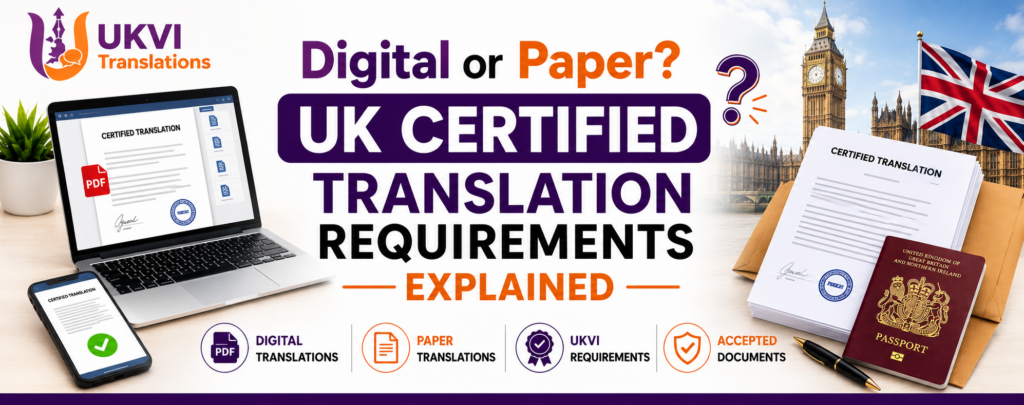
⚡ Quick Answer: A digital certified translation — a signed, stamped PDF carrying a certificate of accuracy — is accepted by UK Visas and Immigration for online visa, settlement and citizenship applications, because Immigration Rules paragraph 39B requires a translation that is complete and independently verifiable, not one that is printed. Paper is still expected by HM Passport Office, the DVLA and most Register Offices, all of which run postal or in-person processes, and by overseas embassies and consulates. Any document heading for FCDO legalisation or an apostille normally needs a wet-ink original, since the Legalisation Office works from a physical signed certificate. Confirm the accepted format with the specific authority before you order, as internal policies differ between departments.
You’ve got the PDF sitting in your inbox. It’s stamped, it’s signed, and it looks official. And yet you’re hovering over the upload button wondering whether you’ve just wasted a week — because somewhere on a forum, someone insisted the Home Office “only accepts originals by post.”
Here’s the honest position after a decade of preparing these files at UKVI Translations: whether a digital certified translation UK authorities will accept is enough has almost nothing to do with the translation itself. It depends entirely on how the receiving department is set up to take documents. One body reads everything through a portal. Another still opens envelopes in Swansea. Same translation, two completely different answers.
Why The Real Question Isn’T “Digital Or Paper” At All
Applicants assume there’s a rule somewhere ranking print above PDF. There isn’t. What every UK authority is actually testing is whether the translation is complete, attributable to an identifiable professional, and checkable if someone picks up the phone.
📌 KEY TAKEAWAYS:
✔ Format follows process. Digital submission channels accept digital certification. Postal channels want the paper in the envelope.
✔ Verifiability outranks physicality. A scannable PDF with full translator credentials beats a posted page with a vague stamp every time.
✔ One exception is absolute. Legalisation and notarisation both need a physical original — no workaround exists.
The Document Requirements Matrix: Who Takes What
We built this from what our certified translators actually see returned to us, not from a policy document. Treat it as your starting point, then confirm with your own caseworker or admissions officer. For official guidance on translated documents for UK visa applications, see the UK Government’s guidance on supporting documents
| Authority | How you usually submit | Digital PDF accepted? | When paper is still needed |
|---|---|---|---|
| UK Visas and Immigration | Online application portal, UKVCAS or VFS appointment | ✔ Yes | Only if a caseworker specifically requests it |
| HM Passport Office | Postal application or Post Office Check & Send | ✖ Usually not | Printed translation posted alongside the original certificate |
| DVLA (licence exchange) | Postal D1/D2 application to Swansea | ✖ Usually not | Printed translation enclosed with your foreign licence |
| HM Courts & Tribunals Service | CE-File or Digital Case System, via a solicitor | ➖ Depends on the centre | Hearing bundles, litigants in person, some tribunal venues |
| GMC, NMC and GDC | Online registration portal | ✔ Usually | Certain verification routes request certified copies by post |
| UK universities & ECCTIS (UK ENIC) | Applicant portal upload | ✔ Yes | Originals shown at enrolment or registration |
| Register Offices and the GRO | In person or by post | ✖ Usually not | Marriage notice appointments, birth and death registration |
| Overseas embassies and consulates | In person at the mission | ✖ Rarely | Almost always an original, frequently legalised too |
| FCDO Legalisation Office | Post or courier | ✖ No | Wet-ink original of the translator’s certificate |
The Home Office Moved Digital Before Most People Noticed
Visa, settlement and naturalisation applications now run through an online account where you attach supporting evidence yourself. Your certified PDF sits next to the scanned original and gets reviewed side by side on screen. Nobody at the Home Office is waiting for a courier.
What genuinely trips applicants up isn’t the format — it’s uploading a translation that’s been cropped, compressed into an unreadable file, or split so the certification page never made it into the bundle. We frequently see applicants get caught out by a phone photo of a printout, which loses far more credibility than the PDF they started with.
Passports, Driving Licences And Register Offices Remain A Paper World
These three run on posted or in-person processes, and their staff physically handle your documents. HM Passport Office wants your foreign birth or marriage certificate in the envelope, with the translation clipped to it. The DVLA expects the same when you exchange a licence. A Register Office giving notice of marriage will want to see paper across the counter.
None of this is a judgement on digital certification. It’s simply that there’s no portal to upload to.
Courts And Tribunals Sit Awkwardly In The Middle
Civil filing has moved onto digital systems, and a solicitor filing electronically will normally include your translation as part of the electronic bundle. What court staff rarely tell you is that individual centres and tribunal venues still ask for printed bundles, and if you’re representing yourself you may be told to bring hard copies on the day.
If a hearing date is involved, order printed copies. The cost of postage is trivial against an adjournment.
Regulators, Universities And Embassies
The GMC, NMC and GDC operate applicant portals that take uploads comfortably. Universities and ECCTIS do the same at application stage, then ask to sight originals when you arrive. Embassies are the outlier — most missions want a physical document in front of them, and many pair that with a legalisation requirement.
The One Scenario Where A Pdf Will Never Be Enough
If your translated document is going anywhere near an apostille, FCDO legalisation, or a notary public, you need the paper version from the outset.
✔ Apostille and legalisation attach to a physical signed certificate. The Legalisation Office is authenticating a real signature on a real page.
✔ A notarised translation requires a notary to witness and seal the document in person.
✔ Retro-fitting is expensive. Ordering the PDF first, then discovering you need legalisation, means reissuing and re-couriering — usually adding a week.
If your case might involve a foreign court, an overseas property matter, or a marriage registered abroad, tell your provider before work begins.
What Actually Makes A Digital Certified Translation Hold Up
A valid PDF isn’t just a scan of a signed page. It carries the certification block naming the translator or company, the completion date and contact details a caseworker can verify — presented on company letterhead. Where a translation is prepared by an ITI or CIOL registered linguist within an ATC member company, that credential trail is what gives a caseworker confidence, whether they’re reading pixels or paper. A digital certified translation should also retain the complete certification details required for verification.
Can I Print My Certified Translation Myself?
Yes, and for most purposes it’s perfectly acceptable. Print it single-sided, in colour, at full size — don’t scale it down to fit. Where a body insists on an “original”, though, self-printing won’t satisfy them; you need copies dispatched by the provider.
Does The Signature Need To Be Wet Ink?
For digital submission, no. Applied signatures and stamps on a certified PDF are standard practice and widely accepted. For legalisation, notarisation and some embassy submissions, wet ink is the requirement, not a preference.
Your Pre-Submission Compliance Check
✔ Confirm the submission channel — portal upload, postal form, or counter appointment
✔ Check every page of the original has a matching translated page, stamps included
✔ Open the PDF at 100% zoom and confirm the certification block is legible
✔ Verify names match your passport spelling exactly, character for character
✔ If legalisation is even a possibility, order the wet-ink copy now
✔ Keep one printed set in reserve for interviews and enrolment
Frequently Asked Questions
Does Ukvi Accept A Certified Translation As A Pdf?
Yes. Online applications are assessed digitally, and a properly certified PDF submitted alongside the scanned original meets the requirement. The rules concern completeness and verifiability, not physical form.
Is An Emailed Certified Translation Valid?
It is, provided the file arrives complete and unaltered with the certification page attached. Forwarding a compressed or screenshotted version is where validity breaks down, not the email itself.
My University Asked For A “Certified Copy” — Is My Pdf Enough?
Usually at application stage, yes. “Certified copy” in admissions language typically means professionally certified rather than physically posted. Ask the admissions office directly, because enrolment often has separate requirements.
Does A Digital Certified Translation Expire?
The certification doesn’t lapse. The underlying document may still need to be recent — financial and medical evidence in particular — so check the currency of the source document rather than the translation.
How Long Does A Certified Translation Take If I Need Paper Too?
Digital delivery is quick, with same-day certified translation available on straightforward documents. Posted copies add dispatch and delivery time, so request them at the point of order rather than afterwards.
I’M Applying From Outside The Uk — Can I Still Get Hard Copies?
Yes, though international delivery adds days and cost. Many overseas applicants take the PDF for the online application and arrange printed copies only if an embassy appointment demands them.
Can I Submit A Scanned Photocopy Of A Printed Certified Translation?
Avoid it. Rescanning degrades legibility and strips the file’s clean provenance. Always upload the original PDF you were issued.
📌 Submit With Certainty: Get Your Uk-Compliant Translation Sorted Today
Our in-house specialists have spent over a decade preparing certified translations for the Home Office, UK courts, regulators and universities — which is why we advise on format before we quote, not after you’ve paid. Every translation leaves us with a full certificate of accuracy and complete translator credentials, and we stand behind it: if any authority ever queries a translation we’ve issued, our certified translators correct and reissue it at no cost. Your documents stay confidential throughout, handled under strict GDPR controls and never shared.
Not sure whether your submission needs a PDF, a posted original, or both? Send us the document and tell us where it’s going. We’ll confirm the correct format for that specific authority before any work starts — request your free format check and instant quote and get a fixed price back within thirty minutes, with same-day delivery available when your deadline is tight.