A paralegal called us on a Thursday afternoon. The hearing was the following Wednesday. Her client had just produced fourteen pages of home country court documents nobody had seen before, all in Amharic, and the bundle had already been filed.
Her question was the right one. Not “can you translate this?” but “if I file this now, will the judge admit it?”
That is the question urgent HMCTS tribunal translations actually turn on. Speed matters, but a translation delivered in four hours is worthless if it arrives in a format the Tribunal will not accept, or on a date that triggers a preliminary admissibility argument you did not plan for. At UKVI Translations, our specialists work to hearing dates rather than to convenience, and this guide sets out what we have learned about getting translated evidence in front of a judge cleanly.
📌 Quick answer: For First-tier Tribunal (Immigration and Asylum Chamber) work, translated evidence must carry a signed certificate of accuracy from an independent qualified translator, and must arrive in a form that drops straight into a digital, indexed, bookmarked and paginated A4 bundle. The binding deadline is rarely the hearing date — it is the point five working days before it, after which the Tribunal decides admission of late evidence as a preliminary issue. Instruct translation against that date, not the hearing.
The Deadline That Governs Urgent Tribunal Translations For Solicitors
Most late instructions we receive are calculated backwards from the wrong date.
Under the Practice Direction in force since 1 November 2024, evidence served late must be accompanied by a written explanation of why it was not provided earlier. Where it lands within five working days of the hearing, admission becomes a matter the Tribunal determines as a preliminary issue — argued before your substantive case is heard.
➔ What that means in practice: a translation delivered the night before the hearing does not simply arrive late. It arrives needing to be argued in.
Work backwards instead:
- Hearing date → your absolute ceiling, never your target
- Five working days before → the real cut-off for clean service
- Two working days before that → when translation must be complete, allowing time for pagination and re-indexing
- Adjournment applications run on their own clock: reasoned, evidenced, and filed no later than 4.30pm one clear working day before the hearing
💡 If the arithmetic no longer works, tell us at the point of enquiry. We would rather advise you honestly that an adjournment application is the safer route than deliver something that hands the Home Office Presenting Officer an easy objection.
What Hmcts Translation Requirements Mean For Your Appeal Bundle
The Practice Direction requires bundles prepared by a legal representative to be digital, indexed, bookmarked and paginated, with every page A4.
That formatting obligation reaches your translations directly, and this is where suppliers outside the legal sector cause avoidable work. A translation issued as a portrait-cropped image, a landscape scan, or a certificate block on a separate loose page has to be reformatted by your paralegal before it can go anywhere near the index.
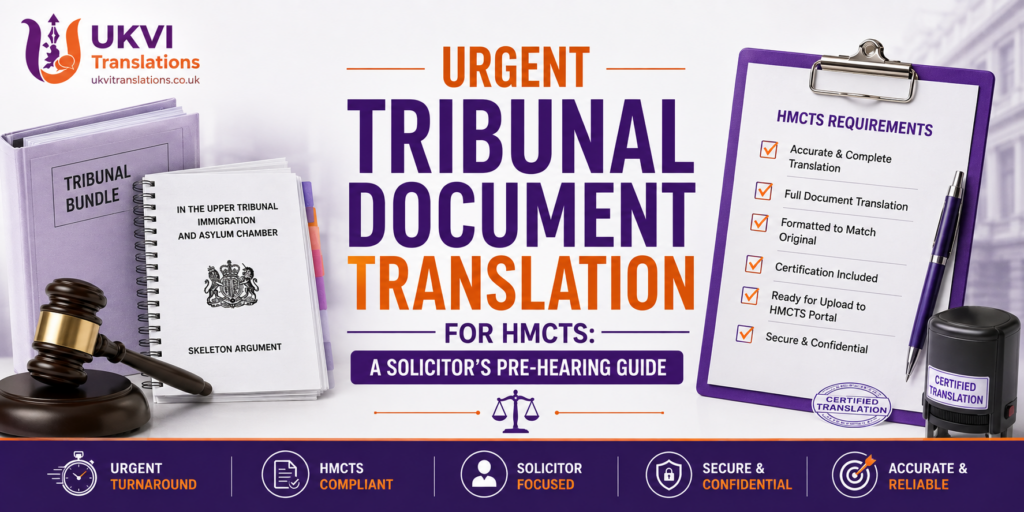
✔ What a tribunal-ready translation should arrive as:
- ✔ A4 portrait throughout, text-searchable PDF
- ✔ One continuous document per source document, not split files
- ✔ Certificate of accuracy bound into the same PDF, not attached separately
- ✔ Original and translation paired and clearly labelled for bookmarking
- ✔ Illegible passages marked as illegible in a translator’s note, never guessed
- ✔ Stamps, seals, handwritten annotations and marginalia all described
📌 Tell us your bundle index convention when you instruct. We will name and order files to match it, which removes a reformatting step from your side entirely.
Witness Statements From Non-English-Speaking Appellants: The Detail Most Providers Miss
This is where we see the most expensive mistakes, and almost nothing is written about it.
The Practice Direction updated its approach to witness statements from people who do not speak English, including how such statements are formatted and attested. A statement that does not reflect how it was actually taken can be challenged on its face, regardless of how accurate the translation is.
Two roles are commonly conflated, and they are not interchangeable:
- An interpreter works live — at the conference where the statement is taken, and at the hearing itself
- A translator works on the written document — the statement, the exhibits, the country evidence
➔ The safest sequence is to take the statement with an interpreter present, record clearly in the statement itself the language used and how it was read back to the witness, and then have the written product handled by an independent qualified translator whose certificate can be verified separately.
Exhibits deserve the same discipline. Where a statement refers to a home country judgment, a police report or a medical letter, an untranslated exhibit weakens the statement that relies on it. If the appeal follows a refused family application, the underlying document set is usually the same one that failed at application stage — our complete UK spouse visa document checklist is a useful cross-check when reconstructing what should have been translated originally.
Certified, Notarised Or Sworn: Choosing The Right Level For Court Documents
Instructions frequently specify a level the matter does not require, or omit one it does. The distinction affects both cost and turnaround, so it is worth settling at the outset.
| ✔ Level | What it adds | When it is typically needed |
|---|---|---|
| Certified | Signed statement of accuracy, translator name, signature, contact details, dated | The standard for tribunal evidence and appeal bundles |
| Notarised | A notary attests the translator’s identity and signature | Where a receiving body specifically requires it, or for use abroad |
| Sworn | Concept from civil law jurisdictions; no domestic UK equivalent | When an overseas authority asks for it by name |
| Apostille / FCDO legalisation | Authenticates the document for use in another state | Onward use overseas, not UK tribunal filing |
📌 There is no domestic register of “sworn translators” in the UK. Where an overseas body uses that term, the closest equivalent is a certified translation by a translator holding recognised professional accreditation. Our translators work to the standards of bodies such as the ITI and CIOL, and we can arrange notarisation where a matter genuinely calls for it.
How To Instruct Us For Same-Day Translation Before A Tribunal Hearing
Speed depends almost entirely on the quality of the instruction. Here is the sequence that produces the fastest reliable turnaround.
- Lead with the hearing date and the hearing centre. Everything is scheduled from that. If your matter sits at a listed IAC centre, say so — it tells us how much slack the timetable holds.
- Send complete source documents, not extracts. Every page, both sides, all stamps legible. Cropped screenshots of “the relevant paragraph” are the single most common cause of delay, because we cannot certify what we cannot see in full.
- State the destination. Appeal bundle, Respondent’s Review response, bail application, Upper Tribunal grounds — the intended use determines format and certification level.
- Flag transliteration conventions early. Where a name appears differently across a passport, a home country judgment and an earlier decision letter, tell us which spelling appears in your Appeal Skeleton Argument. We reproduce the original faithfully and explain variations in a translator’s note rather than silently harmonising them.
- Confirm billing at instruction. We provide a fixed quote before work starts so the sum can be recorded as a disbursement and, where applicable, tested against fixed-fee or legal aid limits without a later surprise.
- Tell us the format you need it back in. Naming convention, index position, whether the certificate should sit at the front or the rear of each translated document.
✔ Before you file, confirm:
- ✔ Every non-English page in the bundle has a paired translation
- ✔ Each translation carries a dated, signed certificate of accuracy
- ✔ The translator is independent of the appellant, the sponsor and your firm
- ✔ Names and dates match your skeleton argument, with variations explained
- ✔ Files are A4, searchable, and named to your index
- ✔ Late-served evidence is accompanied by its written explanation
Confidentiality And Data Handling On Urgent Hmcts Tribunal Translations
Asylum and human rights matters carry obvious risk. Country of origin, family details, medical history and criminal allegations pass through a translation supplier in their most sensitive form, and your professional obligations do not pause when documents leave your office.
When you instruct us, files are handled under GDPR-compliant processes, access is limited to the linguists working on your matter, and documents are retained only for as long as the matter reasonably requires. We are based in Birmingham and act for firms across England, Wales and Scotland — if your practice needs specific retention periods, deletion confirmation, or a signed confidentiality undertaking for a panel arrangement, ask us at instruction and we will confirm in writing.
Frequently Asked Questions On Tribunal Translation For Legal Practitioners
Can You Provide A Witness Statement To Confirm The Translator’S Credentials If The Translation Is Challenged?
Yes. Where the accuracy or provenance of a translation is disputed, we can provide the translator’s qualifications, professional body membership and, where appropriate, a statement addressing the methodology used. Raise it as early as possible so the right linguist is assigned from the outset.
Who Bears The Cost Of Translated Evidence In A Legally Aided Appeal?
Translation is generally treated as a disbursement, subject to the prior authority and rate limits applying to the matter. We provide a fixed written quote before starting so you can seek authority or assess it against a fixed fee, rather than committing on an estimate.
Do We Need To Translate The Entire Document, Or Can We Translate Only The Relevant Extract?
Partial translation is risky and frequently objected to, because it invites the argument that unhelpful passages were omitted. Where a document is long and only part is relevant, the defensible approach is a full certified translation, or a clearly scoped extract translation with a translator’s note recording exactly what was and was not translated.
Can The Same Translator Act As The Interpreter At The Hearing?
It is usually better that they do not. Keeping the written and oral roles separate avoids any suggestion that the person attesting the document also shaped the oral evidence, and hearing centres arrange interpreters independently in any event.
What Happens If The Appellant Disputes Our Translation Of Their Own Document?
Tell us immediately with the specific passage identified. Genuine ambiguity in a source document is common, particularly with handwriting and regional terminology, and it is resolved with a revised translator’s note rather than a rewritten document. What we will not do is amend a translation to say something the original does not.
Can You Handle A Bulk Bundle At Short Notice?
Volume is generally less of a constraint than complexity. Multiple straightforward civil documents can be distributed across linguists, whereas a single handwritten judgment or a technical medical report is bound by the pace of one qualified specialist. Send the page count and a sample when you enquire and we will give you an honest deliverability answer, not an optimistic one.
Final Thoughts On Meeting Tribunal Deadlines Without Compromising Evidence
The paralegal in our opening example filed on the Monday, four working days clear of the cut-off, with a translator’s note explaining two illegible passages. The documents went in without argument.
Nothing about that outcome required heroics. It required calculating from the right date, sending complete originals, and asking one question early instead of three questions late.
If you have a listed hearing and untranslated evidence in front of you now, the most useful thing you can do is tell us the date. Our specialists will tell you plainly what is achievable, what is not, and where an adjournment application is the more defensible course — even when that means we take no instruction at all.
➔ Send us your hearing date and documents for a fixed quote and an honest deliverability assessment
