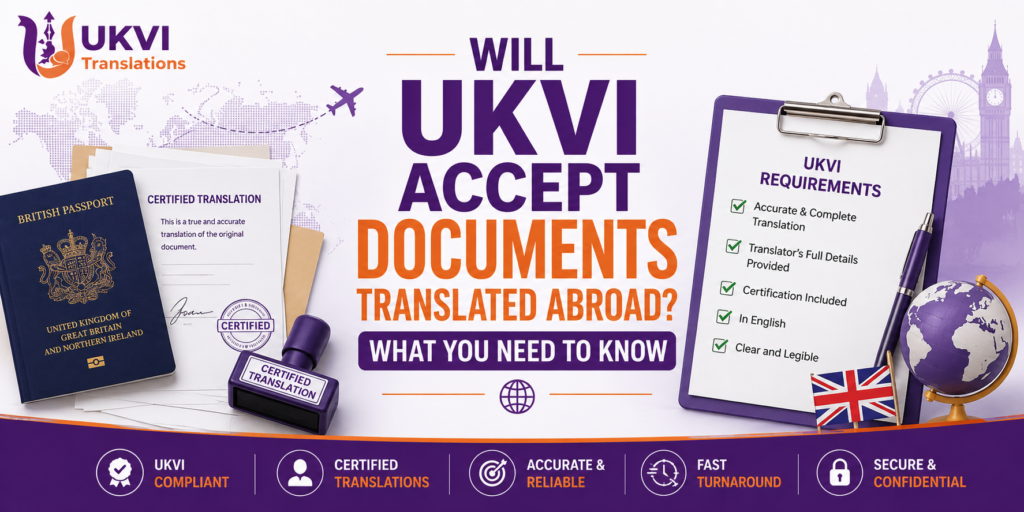
⚡ Quick Answer: UKVI does not require a UK-based translator, so a sworn translation produced in Spain, Italy, Poland, Russia or China can be accepted — but only if it satisfies Immigration Rules paragraph 39B. That means a complete English translation carrying a statement of accuracy, the date of translation, the translator’s full name and signature, and contact details the Home Office can independently verify. Most foreign sworn translations fail on presentation rather than quality, typically because the certification wording is printed in the source language or the notary attested the translator’s identity rather than the accuracy of the text. A UK certified translation costs far less than a refused application, so have your existing document checked against the four-point rule before you submit.
You paid a court-registered professional. There’s a raised seal, a register number, revenue stamps down the side. In your country this document outranks anything a private company could produce.
Then someone in a forum tells you the Home Office “won’t take foreign translations” — and now you’re staring at a file you’ve already paid for, wondering whether you’re about to spend the money twice.
Let’s settle it properly. In our years of preparing immigration files at UKVI Translations, we’ve reviewed hundreds of translations issued abroad. Some sail through untouched. Others get sent back for reasons that have nothing to do with the translator’s competence. The difference is predictable once you know what a caseworker is actually looking at.
Why A Caseworker Reads Your Sworn Translation Differently Than You Do
Here’s the inversion nobody explains. In civil-law countries, authority flows from the person: a translator is appointed by a ministry or a court, entered on a public register, and that status makes their work official. The UK works the other way round. Authority flows from the document. There’s no national sworn translator register in England and Wales, so a caseworker can’t look you up in one — they can only assess what’s printed on the page in front of them.
So when your Polish or Spanish document arrives, nobody is checking a register. They’re checking whether the certification tells them who translated it, that it’s complete and accurate, and how to reach that person if a query arises.
| Common Misconception | The Reality at UKVI |
|---|---|
| “Sworn is a higher grade than certified, so it must be accepted.” | Neither ranks above the other. Only the four-point certification content matters. |
| “The notary’s seal proves the translation is accurate.” | In most systems the notary confirms the translator’s identity or signature — not the accuracy of the text. |
| “A UK translator is legally required for a UK visa.” | No such rule exists. Independence from the applicant matters, not nationality or location. |
| “My translation is fine because it’s stamped and registered.” | If the register number and certification wording are in Spanish, Polish or Mandarin, a caseworker can’t read or use them. |
| “Once translated, it’s valid forever.” | The certification doesn’t lapse, but a name-spelling mismatch against your current passport still causes queries. |
What Each System Actually Produces — And Where It Falls Short
Spain: The Traductor Jurado
Your traductor jurado is appointed through the Ministry of Foreign Affairs and stamps every page with a personal seal and certification formula. The translation quality is rarely the issue. The problem is that the certifying formula is written in Spanish, so the one part of the document a caseworker most needs to read is the one part they can’t. Many sworn translators will issue the declaration bilingually if you ask — most applicants simply never think to ask.
Italy: Asseverazione At The Tribunale
An Italian asseverazione involves swearing an oath before a court clerk, producing a verbale di giuramento bound to the translation with marca da bollo revenue stamps. It’s genuinely rigorous. But the oath record is an Italian court document in Italian, and the stamps and clerk’s endorsements are frequently left untranslated — meaning part of your bundle isn’t in English at all.
Poland: The Tłumacz Przysięgły
Polish sworn translators sit on the Ministry of Justice register, carry a round seal and log each job in a repertorium with a reference number. Polish documents cause fewer problems than most — provided the repertorium entry and seal text are translated too.
Russia: Notarised Translation
This one catches people out badly. A Russian нотариус does not verify your translation. They verify that a named translator appeared before them and signed. Read the notarial wording closely and you’ll often find it says precisely that. So the document carries an impressive seal but may contain no statement that the translation is accurate and complete — which is the single element paragraph 39B genuinely requires.
China: The Notary Office Booklet
Chinese notary offices (公证处) issue a bound notarial certificate, frequently bilingual, stitched and sealed with the original attached. It looks more official than almost anything issued in Britain. The usual gaps are a missing named translator with reachable contact details, and English renderings of place names and institutions that don’t match the spelling used elsewhere in your application.
💡 PRO TIP: Before assuming you need a fresh translation, email the original translator and ask for a signed English-language certificate of accuracy on letterhead, dated and with contact details. Many issue one within a day for a small fee, and that single page can rescue an otherwise sound document.
Run Your Existing Translation Through This Check
Take your document out and work down the list honestly. Each unticked box is a reason a caseworker may come back to you.
- Is the certification statement written in English, not only in the source language?
- Does it explicitly confirm the translation is a true and accurate rendering of the original — rather than merely confirming a signature was witnessed?
- Does it carry the translator’s full name and signature, not just an office stamp or register number?
- Are there working contact details — email, phone, address — that someone in the UK could realistically use?
- Is the date of translation shown?
- Has every page and every marking been translated, including seals, revenue stamps, marginal notes and handwritten annotations?
- Do the name spellings match your current passport exactly, character for character?
- Was the translator independent of you — not a relative, not your employer, not you?
Six or more ticks and your document is probably workable. Three or fewer and you’re better off reissuing than gambling a visa fee on it.
When Retranslating Is The Cheaper Decision
We frequently see applicants get caught out by the sunk-cost trap — protecting a €90 translation while risking a four-figure application fee and months of delay. A few situations where our specialists advise starting fresh rather than patching:
✔ The original translator can no longer be traced.
A closed practice leaves you with unverifiable certification and no route to fix it.
✔ The translation isn’t fully into English.
Bilingual documents sometimes leave key fields sitting in the original script.
✔ Your name has changed since.
Marriage, transliteration standards or a reissued passport can leave your translation and your application disagreeing about who you are.
✔ The bundle is inconsistent.
Three documents from three different offices means place names spelled three different ways — and inconsistency across a set attracts more scrutiny than any single document does.
✔ Legalisation is involved.
Where an apostille under the Hague Convention or FCDO legalisation sits in your chain, mixed-origin certification complicates the paperwork.
Frequently Asked Questions
Will Ukvi Accept A Sworn Translation From My Home Country?
It can, provided the translation is complete, in English, and carries a statement of accuracy with the translator’s name, signature, date and contact details. UKVI assesses the certification content, not the translator’s nationality or foreign registration status.
Is A Sworn Translation The Same As A Certified Translation In The Uk?
No. Sworn status is a legal appointment that exists in civil-law countries and has no British equivalent. A UK certified translation is defined by what the certificate of accuracy contains, which is why documents from either system succeed or fail on the same test.
Do I Need To Retranslate Everything For My Spouse Visa?
Not necessarily. Have the existing set reviewed first — often only one or two documents fall short, and reissuing those is far cheaper than redoing an entire bundle.
My Translation Was Notarised Abroad. Isn’T That Stronger Than Certified?
It’s different, not stronger. Notarisation abroad usually attests to identity or signature. If the accuracy declaration itself is missing, the notarial seal doesn’t supply it.
Can I Translate The Certification Page Myself Into English?
No. Anything you produce yourself breaches the independence requirement. The English declaration must come from the translator or an independent professional.
How Do I Check Whether My Translation Meets Ukvi Requirements?
Send it for a professional review against the four-point rule. Our certified translators do this as a free check before quoting, so you know whether you need a full reissue or nothing at all.
Does An Apostille Make My Foreign Translation Acceptable?
Not by itself. An apostille authenticates a signature or seal for international use — it says nothing about whether the translation is complete or accurately certified.
📌 Avoid Paying Twice: Have Your Foreign Translation Checked Before You Submit
Our in-house specialists have spent over a decade preparing certified translations for the Home Office, UK courts, universities and professional regulators, and we’ve handled documents from every sworn and notarial system in Europe and Asia. Every translation we issue carries a full certificate of accuracy with verifiable translator credentials, and we stand behind it — if any UK authority ever queries our work, our certified translators correct and reissue it free of charge. Your documents remain strictly confidential from the moment they reach us.
Don’t reorder blindly and don’t submit on hope. Send us the translation you already hold and tell us which application it’s for. We’ll tell you honestly whether it will pass as it stands, needs a supplementary English declaration, or should be reissued — get your free foreign translation compliance check and receive a fixed quote back within thirty minutes, with same-day dispatch available on urgent deadlines.