Imagine Anna, a German national, has lived and worked in the UK for several years. She is finally ready to apply for British citizenship. While preparing her documents, she notices that her birth certificate is still in German. Since she speaks fluent English, she thinks, “Why pay for a translation when I can do it myself?”
It sounds like a sensible way to save money. Unfortunately, this is where many applicants make a costly mistake.
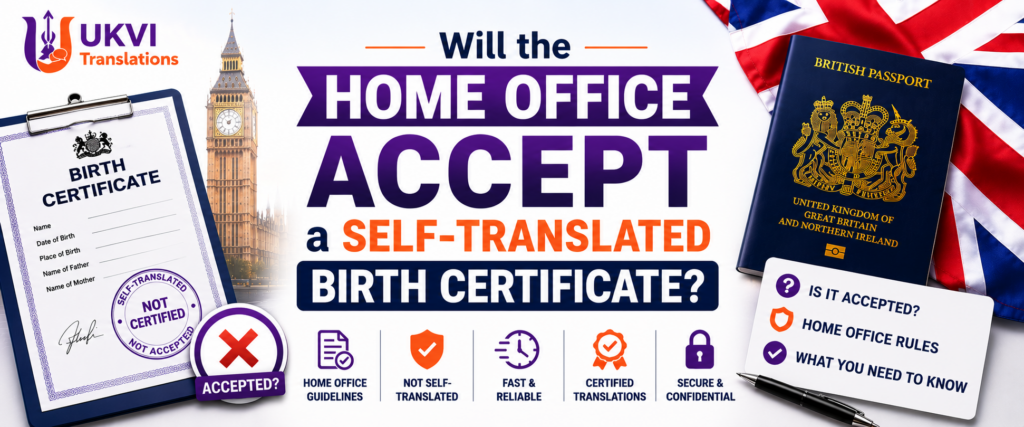
Quick Answer: No. In almost every case, you should not translate your own birth certificate for a UK citizenship application. The Home Office expects an independent, accurate and verifiable translation that meets its official document requirements. A self-translated document can create doubts about impartiality, accuracy and authenticity, even if every word is correct.
If you’re searching Can I translate my own birth certificate for UK citizenship, you’re probably trying to avoid unnecessary costs while making sure your application is accepted the first time. That’s a smart approach.
This guide explains why the Home Office does not usually accept self-translated birth certificates, what could happen if you submit one, and the safest way to avoid delays or requests for additional documents.
At UKVI Translations, we regularly assist applicants preparing documents for British citizenship and other UK immigration applications. From our experience providing professional UKVI translations, one of the most common mistakes we see is applicants assuming they can translate their own documents simply because they are fluent in English.
Why Self-Translated Birth Certificates Usually Get Rejected
The biggest misunderstanding is that the Home Office rejects self-translations because applicants cannot speak English well.
That isn’t the real reason.
The issue is trust.
When you submit documents for British citizenship, every supporting document becomes part of a legal immigration assessment. The caseworker must be confident that nothing has been added, removed or interpreted differently from the original document.
If you translate your own birth certificate, you become both:
- the applicant, and
- the translator.
That creates what immigration authorities call a conflict of interest.
Even if your translation is completely accurate, the Home Office has no independent person confirming that accuracy. Because of this, a self-translated document carries far less evidential value than one completed by a professional third-party translator.
Think about it this way.
If someone marks their own exam paper, nobody can independently verify the result.
The same principle applies to official immigration documents.
For this reason, applicants who ask “Can I translate my own documents for UK Home Office?” usually receive the same practical advice: use an independent certified translator who can confirm that the translation is complete and accurate.
This policy protects both the applicant and the Home Office by ensuring every translated document can be trusted if questions arise during the citizenship assessment.
Home Office Checks More Than Just Translation Accuracy
Many applicants believe the Home Office only checks whether the English words are correct.
In reality, the review process goes much further.
When a caseworker receives a translated birth certificate, they must be able to trust who produced the translation, how it was prepared, and whether it can be independently verified later.
That is why self-translated documents often fail to meet official expectations.
The Home Office generally expects an official translation to provide clear evidence that it came from an independent professional. If questions arise during the assessment, there should be a way to verify the work with the translator or translation provider.
A self-translation cannot offer that level of independent verification.
Professional translations normally include information such as:
- A signed Statement of Accuracy confirming the translation is complete and accurate.
- The translator’s full name.
- Professional qualifications or relevant credentials.
- Company details and contact information.
- The translation date.
- A certification statement linking the translation to the original document.
Without these details, caseworkers may struggle to confirm the authenticity of the translated document.
Over the past 15+ years, we’ve seen applicants lose valuable time because they assumed translating their own birth certificate would be acceptable. In many cases, they later needed to arrange a new certified translation before their application could continue.
The lesson is simple.
The question isn’t whether you can translate your own birth certificate.
The real question is whether the Home Office can confidently trust and verify that translation without an independent professional behind it.
Why the Home Office Rejects Self-Translated Documents
Many websites simply say, “The Home Office requires certified translations.” That answer is incomplete.
The better question is why the Home Office has this rule in the first place.
The policy is not designed to make the process harder. It exists to protect the integrity of every citizenship application and ensure every translated document can be trusted.
Here are the five biggest reasons self-translated birth certificates are commonly rejected.
1. Conflict of Interest
When you translate your own birth certificate, you become both the applicant and the translator.
That creates a clear conflict of interest.
From the Home Office’s perspective, there is no independent person confirming that every word matches the original document exactly. Even an honest applicant cannot provide impartial evidence for their own application.
Independent verification is one of the main reasons professional translators are used for official immigration documents.
2. No Independent Way to Verify the Translation
Imagine a caseworker notices a spelling difference between your passport and your translated birth certificate.
With a professionally prepared translation, they can identify who completed the work and verify it if necessary.
With a self-translation, there is nobody independent to contact.
This lack of accountability makes it much harder for the Home Office to rely on the document with confidence.
3. Missing Statement of Accuracy
Official translations normally include a signed declaration confirming that the translation is a true and accurate representation of the original document.
This is often called a Statement of Accuracy.
It is an important safeguard because the translator accepts professional responsibility for the work.
If you write and sign this statement yourself, it carries very little independent evidential value because you are directly involved in the outcome of the application.
4. Important Parts of the Document Are Left Untranslated
Applicants usually focus on the obvious information.
They translate:
- Name
- Date of birth
- Parents’ names
- Place of birth
But official birth certificates often contain much more.
Professional translators also translate:
- Government seals
- Registration stamps
- Marginal notes
- Official annotations
- Handwritten remarks
- Administrative references
Missing even one of these details may lead the Home Office to question whether the translation is complete.
5. Legal Terminology and Formatting Mistakes
Birth certificates follow different legal formats around the world.
A literal translation rarely reflects the legal meaning intended by the issuing authority.
Professional translators understand how official terminology should appear in UK immigration documents. They also preserve the structure of the original certificate, making it easier for caseworkers to compare both versions side by side.
That attention to detail reduces unnecessary questions during the assessment process.
⚠️ Important: A translation can be linguistically correct and still fail to meet the Home Office’s documentary standards. Accuracy alone is not enough. Independence, completeness and verifiability matter just as much.
Submitting Your Own Translation Can Create Bigger Problems
Many applicants search “Does UKVI accept self translated documents” because they hope to save money on their citizenship application.
The potential saving may look worthwhile at first.
The possible consequences often are not.
If a caseworker cannot rely on your translated birth certificate, several things may happen depending on your application.
You could be asked to:
- provide a new certified translation before processing continues
- submit additional supporting evidence
- explain inconsistencies between documents
- wait while your application is reviewed again
Each extra request means more waiting.
If your citizenship application fee has already been paid, delays become far more frustrating because your case cannot move forward until the document issue is resolved.
We’ve seen applicants spend weeks correcting a problem that could have been avoided before submission.
This is especially common when applicants rely on:
- Google Translate
- AI translation tools
- bilingual relatives
- friends who speak both languages
- their own translation skills
Although these options may produce understandable English, they do not solve the Home Office’s main concern—independent verification.
For that reason, applicants asking “Who can translate documents for UK citizenship?” are generally advised to use an experienced professional translator who understands official UK document requirements rather than someone personally connected to the application.
A Simple Check Before You Submit Your Application
Before uploading your birth certificate with your citizenship application, ask yourself these five questions:
✔️ Is every word, stamp and handwritten note translated?
✔️ Can the Home Office identify who completed the translation?
✔️ Does the translation include a signed Statement of Accuracy?
✔️ Can the translator be contacted if verification is needed?
✔️ Would an independent caseworker trust this translation without asking further questions?
If you answered “No” to even one question, it is worth reviewing your documents before submission.
That small step today could save weeks of delays later.
The Safest Way to Submit Your Birth Certificate
If you’ve reached this point, you already know the answer to the question “Can I translate my own birth certificate for UK citizenship?”
The safer option isn’t simply to hire a translator. It’s to make sure your translation meets the standards that the Home Office expects from the very beginning.
Before you upload your citizenship application, use this checklist.
Your translation should include:
✔ A complete English translation of every part of the birth certificate.
✔ All government stamps, seals and handwritten notes translated.
✔ A signed Statement of Accuracy.
✔ The translator’s name and professional details.
✔ The translation date.
✔ Contact information that allows the translation to be verified if required.
If even one of these elements is missing, you may be asked to submit a replacement translation before your application can move forward.
If you’re unsure whether your existing translation meets these standards, it’s worth having it checked before submitting your documents. Many applicants only realise something is missing after UKVI requests additional evidence.
Where a new translation is needed, our Birth Certificate Translation service can prepare a compliant version that follows UK Home Office requirements. If you’re submitting several immigration documents together, our UK Citizenship Document Translation service keeps every translated document consistent across your application.
At UKVI Translations, our goal isn’t simply to provide UKVI translations. We aim to help applicants submit complete, accurate and professionally certified documents that give the Home Office confidence from the very beginning.
Frequently Asked Questions
Can a family member translate my birth certificate for UK citizenship?
It is generally not recommended.
Even if your family member is fluent in both languages, they are not considered independent because they have a personal relationship with the applicant. That can reduce the credibility of the translation during the assessment process.
Will UKVI accept a translation created using AI or Google Translate?
No.
Machine translation tools may produce understandable English, but they cannot provide professional certification, independent accountability or a signed Statement of Accuracy. Those requirements cannot be replaced by automated translation software.
My birth certificate already has some English text. Do I still need a full translation?
Possibly.
If important sections, stamps, handwritten notes or official remarks remain in another language, the Home Office may still require a complete certified English translation covering the entire document.
What if my birth certificate contains spelling differences from my passport?
Do not change the wording yourself.
A professional translator should translate the document exactly as it appears. If spelling differences exist between documents, they should remain accurate, and any supporting explanation should be provided separately where appropriate.
Can I submit my citizenship application first and send the translation later?
That depends on your circumstances, but it is rarely the safest option.
If the translation is required and missing, your application may be delayed while UKVI requests additional documentation. Submitting everything correctly from the beginning usually avoids unnecessary waiting.
Does a certified translation expire for UK citizenship applications?
A certified translation does not usually have an expiry date.
However, if the original birth certificate has been replaced, amended or reissued, you should obtain a new certified translation based on the latest version of the document.
Avoid Delays Before You Submit Your Application
Trying to translate your own birth certificate may seem like an easy way to save money, but it can create questions that delay your UK citizenship application. The Home Office needs more than accurate English. It needs a translation that is complete, independently verified and professionally certified.
If you’re still unsure whether your current translation is suitable, don’t leave it to chance.
Complete the enquiry form beside this page, upload a clear copy of your birth certificate, and we’ll review your documents before you apply. If a certified translation is needed, we’ll explain exactly what’s required and recommend the most suitable solution for your application. Get a free quote now and let At UKVI Translations help you submit your UK citizenship application with confidence.
A few minutes spent checking your documents today could save weeks of unnecessary delays later.