Jules , an engineer from Madrid, had translated his university degree and birth certificate before applying for a UK Skilled Worker visa. Everything looked accurate, and the translator assured him the documents were suitable for submission.
However, before uploading his application, Jules spoke to an immigration adviser who asked a simple question:
“Is your translation issued by an ATC member company?”
Jules had never heard of the Association of Translation Companies (ATC). After a quick online search, he found dozens of discussions claiming that the UK Home Office rejects translations without an ATC member stamp. Suddenly, he wasn’t worried about the translation itself—he was worried that he’d chosen the wrong provider.
If you’ve searched why Home Office rejects translations, you’ve probably seen similar advice.
The truth is more nuanced than many websites suggest.
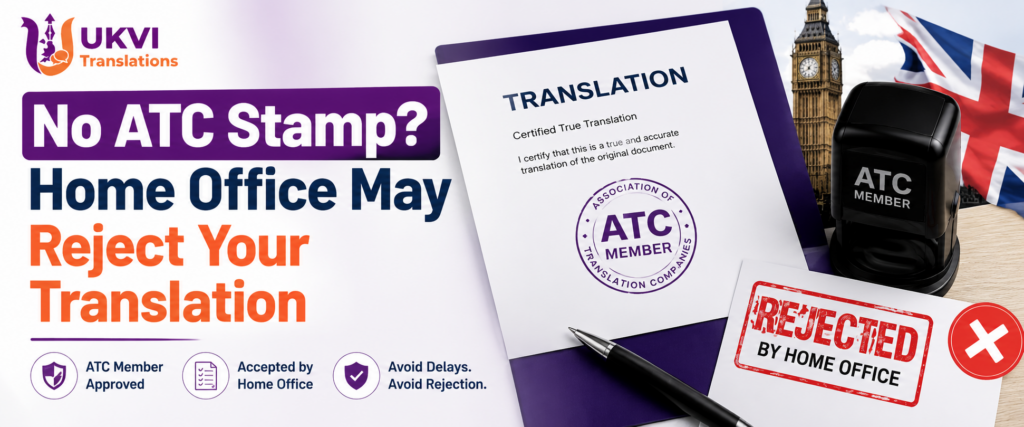
A missing ATC member stamp isn’t automatically a reason for rejection. What usually matters is whether the translation gives UK Visas and Immigration (UKVI) enough confidence that it was prepared by a professional, verifiable and properly certified translation provider. In many cases, ATC membership supports that confidence, which is why it is frequently recommended for official UK applications.
Understanding this distinction can help you avoid unnecessary delays, replacement requests and the cost of ordering a second translation after your application has already been submitted.
At UKVI Translations, we’ve reviewed thousands of certified translations submitted for UK visa and immigration purposes. From our experience, applicants often assume an ATC member stamp alone determines whether a translation will be accepted, when in reality UKVI looks at the overall quality, certification and verifiability of the document.
Quick Summary: Why the ATC Stamp Matters for UKVI
The UK Home Office does not reject every translation simply because it lacks an ATC member stamp. Instead, UKVI looks for evidence that the translation is accurate, professionally certified and easy to verify. An ATC member stamp is one recognised indicator of professional standards, which is why translations without it may receive closer scrutiny if other certification details are also missing.
We always recommend focusing on the complete certification rather than a single trust signal. A professionally prepared translation that meets UKVI expectations is far more important than relying on one logo or stamp alone.
Is the ATC Member Stamp Really the Reason?
Not always. In most cases, the missing stamp is only part of a bigger verification picture.
One of the biggest misconceptions surrounding UK visa applications is that the Home Office has a rule requiring every certified translation to carry an ATC member stamp.
In reality, applicants often reach this conclusion because many rejected translations happen to come from providers that cannot easily demonstrate their professional credentials. As a result, the missing ATC stamp becomes the feature people notice first—even though the actual concern may be the translation’s overall credibility.
Think about it from a UKVI caseworker’s perspective.
They review thousands of supporting documents every year, covering dozens of languages they may not personally understand. Their job isn’t simply to read translated text; it’s to decide whether the translation can be trusted as an accurate representation of the original document.
That’s why professional verification matters.
A translation that includes clear certification details, company identification, translator credentials and an Official Statement of Accuracy immediately provides more confidence than one containing only translated text with no supporting information.
This is also why many immigration advisers recommend choosing a professional translation company UK with recognised quality processes. The recommendation isn’t based solely on the presence of an ATC logo—it reflects the wider importance of accountability, traceability and consistent certification standards.
Unlike a generic freelance translation, a professionally certified translation gives UKVI a clear trail showing who prepared the document, how it was certified and how the provider can be verified if further checks are required.
Why Do Caseworkers Need More Than Just a Translation?
Because UKVI is not only assessing what your document says—they also need confidence that the translation itself is genuine, complete and professionally certified.
This is where many applicants misunderstand the process.
When a caseworker receives a translated document, they are usually not fluent in the original language. Instead of checking every translated sentence, they first look for evidence that the translation has been prepared by a reliable and identifiable source.
In simple terms, they ask questions like:
- Who translated this document?
- Can the translator or company be identified later if required?
- Does the certification confirm that this is a true and accurate translation?
- Has every part of the original document been translated?
If those questions are answered clearly, reviewing the document becomes much easier.
If they’re not, UKVI may ask for a replacement translation before continuing with the application.
This explains why two translations of the same document can receive different outcomes. The difference is often not the language itself, but the level of professional verification supporting it.
Five Situations Where A Missing ATC Member Stamp Can Raise Questions
A missing ATC member stamp rarely causes problems on its own. However, it can increase scrutiny when other trust signals are also missing.
Below are the situations where applicants are most likely to experience delays or additional document requests.
We’ve seen these issues arise repeatedly when applicants choose providers based only on price instead of professional certification and document compliance.
1. The Translation Cannot Be Linked To A Professional Provider
If a translation contains no company details, website, business information or identifiable translator, UKVI has little evidence to verify where it came from.
An ATC member company normally provides transparent business information, making independent verification much easier.
2. Important Certification Details Are Missing
A professionally certified translation should normally include:
- An Official Statement of Accuracy
- Translator or company details
- Contact information
- Certification date
- Signature or authorised certification
When several of these details are missing, applicants often assume the absence of an ATC stamp caused the problem. In reality, the concern is the lack of professional certification as a whole.
3. The Original Document Has Not Been Fully Translated
One of the most overlooked mistakes is leaving out:
- Official stamps
- Handwritten notes
- Marginal comments
- Seals
- Signatures
Even if the main text has been translated perfectly, missing these elements can make the document appear incomplete.
4. The Translation Comes From An Unknown Freelancer
There is nothing wrong with independent translators. Many are highly skilled professionals.
The difficulty arises when there is no straightforward way to verify their credentials or certification process.
Established translation companies usually follow documented quality procedures, maintain business records and provide consistent certification formats. These factors make document verification easier for organisations reviewing official applications.
5. Previous Applications Have Already Been Questioned
If an applicant has previously been asked to submit replacement translations, caseworkers may examine future submissions more carefully.
In these situations, applicants often prefer using a professionally certified UKVI translation from a provider that follows recognised industry standards, helping to reduce the risk of repeated document queries.
How A Translation Is Usually Verified Before A Decision
Instead of focusing on a single ATC logo, think of document verification as a series of trust checks.
| Verification Stage | What UKVI Is Looking For |
|---|---|
| Identity | Who completed the translation? |
| Certification | Does it confirm the translation is true and accurate? |
| Accountability | Can the translator or company be contacted if needed? |
| Completeness | Are every page, stamp and handwritten note translated? |
| Consistency | Do names, dates and reference numbers match the original document? |
When all five stages are satisfied, a translation is generally much easier for a caseworker to review confidently.
This is why experienced immigration advisers often recommend understanding the requirements for a Certified UKVI translation accepted by the Home Office before submitting foreign-language documents. Knowing what should appear on a certified translation can help you identify potential issues before they delay your application.
How Can You Check If An ATC Member Stamp Is Genuine?
The safest way to verify an ATC member stamp is to confirm that the translation company is an active member of the Association of Translation Companies (ATC) and that the certification details match the company issuing your translation.
A professional-looking stamp alone shouldn’t be the reason you trust a translation. Before submitting important documents to the UK Home Office, spend a few minutes checking the provider’s credentials.
Use This Simple Verification Checklist
✔ Search the company in the ATC Member Directory
A genuine ATC member should appear in the official membership directory with matching business details.
✔ Compare the company name
The company name on your certified translation should match the name shown on the ATC membership record and the company’s official website.
✔ Review the certification statement
Every certified translation should clearly state that it is a true and accurate translation of the original document.
✔ Check the translator or company details
A professionally prepared translation should include identifiable contact information, making it possible to verify the document if requested by UKVI.
✔ Look for consistency across every page
Company branding, certification wording and document formatting should remain consistent throughout the translation.
If any of these details appear incomplete or inconsistent, it’s worth asking the provider for clarification before submitting your application.
Before You Apply: A Two-Minute Translation Check
Many applicants only realise there’s a problem after receiving an email asking for replacement documents.
A quick review before submitting your application can help avoid that situation.
Ask yourself these six questions.
✓ Is every page of the original document translated?
Missing pages can make the document appear incomplete.
✓ Are stamps, seals and handwritten notes included?
These often contain information that UKVI may need to understand.
✓ Does the translation include an Official Statement of Accuracy?
This is one of the key certification details expected on professionally certified translations.
✓ Can the translation provider be identified easily?
The company name, contact details and certification information should all be visible.
✓ Do all names, dates and reference numbers match the original document?
Small inconsistencies can create unnecessary questions during the review process.
✓ Can the translation be independently verified if required?
If the answer is “yes”, you’ve significantly reduced the risk of avoidable translation-related queries.
If your translation meets these requirements but you’re working against a tight visa deadline, our guide on how to Get a 4-Hour Certified Translation for an Urgent UK Visa Application explains how the urgent translation process works, which documents can realistically be completed within four hours, and how to avoid delays while still meeting UKVI requirements.
Frequently Asked Questions
If my translation doesn’t have an ATC member stamp, should I order a new one?
Not necessarily. First, check whether your translation already includes all the certification details expected by UKVI. If the translation is professionally certified, complete and verifiable, an additional translation may not be required.
Will the Home Office explain exactly why a translation was questioned?
Usually, you’ll receive a request explaining that a replacement or properly certified translation is needed. However, the notification may not identify one specific issue, which is why reviewing the entire certification is important.
Can I ask my translator to add an ATC stamp afterwards?
No. An ATC member stamp can only be used by an organisation that is genuinely registered with the Association of Translation Companies. It cannot simply be added to an existing translation after it has been issued.
Does ATC membership matter for every UK immigration application?
Different immigration routes involve different supporting documents, but the underlying expectation remains the same: translations should be accurate, professionally certified and capable of independent verification.
What happens if the translation company closes after issuing my documents?
If UK authorities need to verify the translation and the provider can no longer be contacted, the process may become more difficult. Choosing an established translation company with a proven track record helps reduce that risk.
Final Thoughts
Many people search online believing that the UK Home Office rejects translations simply because they don’t have an ATC member stamp. In reality, the missing stamp is often part of a much wider issue.
The Home Office and UKVI are primarily looking for translations that are accurate, professionally certified and easy to verify. An ATC member stamp is one recognised way of demonstrating professional standards, but it works best when supported by complete certification details, clear translator credentials and a transparent verification process.
Before submitting your application, take a few minutes to review your translation using the checklist in this guide. If you’re unsure whether your documents include the certification details expected for official UK submissions, simply upload them using the enquiry form beside this article. At UKVI Translations, we’ll review your documents and let you know whether anything should be corrected before you apply, helping you avoid unnecessary delays and replacement requests. Get a free quote now and receive expert guidance before submitting your UK visa application.
About the Author
Written by David Morgan
Senior Translation Specialist
David has more than 15 years of experience translating legal, immigration and official documents for UK visa applicants, businesses and legal professionals. His work focuses on producing professionally certified translations that meet UK documentation standards and support smooth application processes.