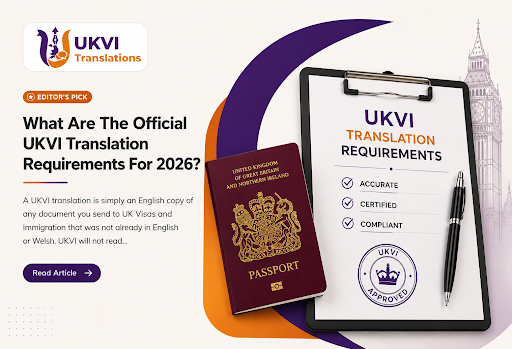
A UKVI translation is simply an English copy of any document you send to UK Visas and Immigration that was not already in English or Welsh. UKVI will not read your foreign language document on its own. It needs an English version next to it, done in a certain way, or your application can get stuck.
This blog explains that “certain way” in full. You will learn when you need a UKVI certified translation, what it must contain, who is allowed to prepare it, whether it needs notarising, which documents usually need one, and what has changed for 2026. No filler. Just the correct rules, explained in plain words.
When Do You Need A UKVI Certified Translation?
If any document you are sending to UKVI is not written in English or Welsh, you need a translation of it. This is true for every visa type. There is no exception.
- Applies to visitor visas, spouse visas, student visas, work visas, and settlement (ILR)
- Applies no matter how well you personally speak English
- Applies to the whole document, not just parts you think matter
- The translation must go alongside your original document, not replace it
What Must A Home Office Translation Include?
A home office translation is only valid if it carries a proper certificate. Missing even one part of this certificate can get your document rejected. UKVI is strict about this.
- A written statement that the translation is a true and complete copy of the original
- The date the translation was finished
- The full name and signature of the translator, or of an authorised person from the translation company
- Contact details for the translator or the company, so UKVI can check who did the work
Who Can Give You A Certified Translation For UK Visa Use?
Not everyone can translate your documents for UKVI. The person must be independent of your case.
- A professional translator or a translation company must do the work
- You cannot translate your own documents, even if your English is excellent
- A family member, partner, or friend cannot translate for you either
- The translator should have no personal connection to your application
- For leave to remain and ILR cases, UKVI also expects the translator’s credentials to be clearly stated
Do You Need A Notarised UKVI Approved Translation?
This confuses a lot of applicants, so it is worth stating clearly.
- Notarisation is not required for a standard UKVI approved translation
- A properly certified translation, with the four points above, is enough on its own
- Paying extra for a notary stamp adds cost but no real benefit for a standard visa case
- Notarisation is sometimes needed for separate legal matters, not for most visa or immigration submissions
- If you are unsure, ask your immigration adviser rather than paying for notarisation by default
Which Documents Usually Need A UKVI Translation?
Most applicants need more than one document translated. Here are the ones that come up again and again.
- Birth certificates and marriage certificates
- Divorce papers and death certificates
- Police clearance certificates
- Bank statements and payslips
- Academic transcripts, degree certificates, and school records
- Employment letters and sponsor letters
- Any stamp, seal, or handwritten note on the original document
Stamps and handwritten notes are often missed. UKVI expects these to be described in the translation too, not left out because they are hard to read.
What Happens With Documents That Are Part English?
Some original documents are already partly in English. This needs careful handling.
- Only the non-English sections need to be translated
- The translation should clearly state which parts were already in English
- This avoids any confusion about whether a section was missed by mistake
- Common examples include bank statements with English headers but foreign handwriting
What Has Changed For UKVI Translation Rules In 2026?
The core certified translation rules have not changed for 2026. What has changed sits around them.
- A proposal to raise the qualifying period for Indefinite Leave to Remain from five years to ten years for points-based migrants is expected to start around April 2026
- This is not a translation rule, but it affects ILR cases, which already carry stricter translator credential requirements
- More of the UK visa system now runs through digital portals and online document uploads
- Digital review means a translation is often checked as a standalone file next to a scanned original, so it needs to match cleanly on its own
How Long Does A UKVI Certified Translation Stay Valid?
A certified translation does not expire on its own, but the document behind it can. This is a common mix-up.
- The translation itself has no fixed expiry date
- The original document may still need to be recent, depending on its type
- Bank statements are usually expected to be within 28 days of your application
- Employment letters are usually expected to be within about 3 months
- It is safest to get your translation done close to your actual application date, not months in advance
UKVI Certified Translation vs Notarised vs Sworn Translation
These three terms get mixed up all the time, and using the wrong one can cost you money for nothing.
- A certified translation carries a signed statement of accuracy from the translator
- A notarised translation adds a notary public who confirms the translator’s identity, not the translation quality
- A sworn translation is a term used in some other countries and does not directly apply to UK certified translation rules
- UKVI asks for a certified translation as standard, not a notarised or sworn one
- Only ask for notarisation if a specific solicitor, court, or overseas authority tells you it is needed
What Format Should A UKVI Approved Translation Be In?
Format matters more than people expect, especially now that most documents are uploaded online rather than handed over in person.
- The translation should be a full page-by-page match of the original document
- Page order should follow the same order as the original
- Digital copies in PDF are accepted for most online UKVI applications
- Printed copies are worth keeping on hand in case a physical version is ever requested
- A translation that is easy to place next to its original and check line by line causes fewer problems
Do UKVI Translation Rules Change By Visa Type?
The core rule stays the same across every visa route, but a few routes carry extra weight on top of it.
- Visitor visas and student visas mostly follow the standard four-point certificate rule
- Spouse and family visas often involve more documents, such as relationship evidence, so consistency across the whole set matters more
- Skilled Worker and sponsor licence cases sometimes involve business documents on top of personal ones
- Leave to remain and ILR cases carry the added expectation of clear translator credentials
- Citizenship applications can involve older documents, so double-check that translations still reflect the current spelling of names and places
Where To Get A UKVI Certified Translation Online
Most applicants now order translations online rather than visiting an office in person, which is faster if you choose the right place. UKVI Translations is a good starting point, since it is built specifically around UKVI and Home Office rules rather than general translation work. Here is why it works well for this exact purpose.
- Every certificate follows the full four-point format UKVI expects, so nothing is left out
- Translators are Home Office approved, which matters for stricter cases like ILR
- One team handles your whole document bundle, keeping names, dates, and formatting consistent
- Same-day delivery is available, useful when your visa deadline is close
- Files are handled securely and kept private throughout your case
Common Reasons UKVI Translations Get Rejected
Most rejected translations are correct in language but wrong in small details. These are the most common ones.
- Certificate missing one of the four required parts
- Translation done by the applicant or a family member
- Original document not submitted alongside the translation
- A stamp, seal, or handwritten note left untranslated
- Name spelled differently across two different translated documents
- Dates written in the wrong order for UKVI to read correctly
- Underlying document too old, such as a bank statement translated weeks after it was issued
A Simple Way To Check Your Translation Before You Submit
Before you submit anything, run through this short list.
- Does the certificate include a statement of accuracy, a date, a name and signature, and contact details?
- Was the translation done by an independent professional, not you or a relative?
- Is the original document included with the translation?
- Are all stamps, seals, and handwritten notes translated or clearly described?
- Do names and dates match exactly across every document in your bundle?
- Is the underlying document still within any required time limit, such as 28 days for bank statements?
If you can answer yes to all six, your UKVI certified translation is in good shape to submit with confidence.
Frequently Asked Questions
Can I use a translation I got done in my home country before moving to the UK?
Yes, as long as it still has the full certificate of accuracy, a date, a signature, and contact details. If any of these are missing, UKVI can still reject it, no matter which country it was done in.
What if my document has two different foreign languages on it?
Both languages need to be translated into English within the same document. The translator should keep the layout matching the original so it is clear which translated section belongs to which original section.
Can I ask for changes after my translation has already been certified?
Yes, most translators will correct a genuine error, such as a spelling mistake, and re-issue the certificate. Once changes are made, the certificate date should also be updated to match.
Does UKVI ever contact the translator directly?
It can happen, though it is not common. This is exactly why the certificate needs real, working contact details. A translator who cannot be reached if UKVI does follow up puts your case at risk.
Can I reuse the same certified translation for a different application later?
Often yes, if the original document has not changed and the translation still meets the four-point certificate rule. It is worth checking the date and condition of the underlying document before reusing it.
Is a translation ever rejected even when every word is correct?
Yes. Most rejections at UKVI happen because of formatting or certificate issues, not language mistakes. A perfectly accurate translation can still be sent back if a required detail on the certificate is missing.
Do UKVI translations need to be on official letterhead?
There is no fixed rule requiring letterhead, but having the translator’s or company’s details printed clearly on the document makes it easier for UKVI to identify and trust the source.
Conclusion
UKVI translation rules are not complicated once you separate the real requirements from the myths. You need a full English translation of anything not already in English or Welsh, a proper four-point certificate, an independent translator, and your original document attached. Notarisation is not needed unless someone specifically asks for it.
What has changed for 2026 is less about the rules themselves and more about how closely they get checked, since more of the process now runs through digital systems. Getting these small details right the first time is the simplest way to keep your visa application moving without unnecessary delays.